
Ch-Ch-Changes
Dec 19, 2025
6 min read
December Reflection—2025
The successful end to a growing season is something we never take for granted. There are countless ways to get knocked down in farming, so every December, when we give thanks for the season, we really do mean it. But this December, we really, really mean it. Because there was no guarantee, back in January, that the 2025 season would even launch, let alone be successful. We had CSA income, but no contract, and without a contract (we assumed), the season couldn’t begin. But a season delayed is a season denied, so we put the question to our CSA members—do we take a chance and buy seeds, or do we fold? The answer was fast, loud, and clear: buy seeds. So we did. Eleven months later, we are still without a contract, but we also have another season of food and memories under the belt. Considering it almost didn’t happen, we have every reason to be very, very grateful.

So, how did this season-that-almost-didn’t-happen measure up? Quite well, I think. There has never been a year where I’ve looked back and thought well that went exactly as planned. If I had any specific goals for 2025, it was simply to bounce back from 2024, when late blight ravaged our fruit crops, the winter squash especially. Thankfully, this year’s fruits did just fine—more tomatoes, peppers, and eggplant than we could handle at times, plus plenty of winter squash. Leafy greens were abundant. Root crops, too. On the flip side, rabbits mowed down half the asparagus, seedcorn maggot claimed half the onions, and the garlic, though vigorous, was small. These results were disappointing, but within the bounds of normal. Every season has its casualties, which is why biodiversity is so important.


For the second time in three years, we worked with a mostly-new crew. Nancy Galgano and Jackie Ford returned for their fifth seasons, but Thomas Lennon, Alice Sztabinski, Vivian Babich, and Sarah Lynas Koenig were new to both the farm and vegetable farming. What this year’s crew lacked in experience, however, they made up for in spirit. Rites of passage like marveling over funky carrots, learning to drive the farm truck, and managing to not get mauled by terrorist rooster Eddie G sparked a lot of laughter. Lunchtime conversations were lively. The farm’s lending library circulated many books. Common purpose fueled camaraderie, making the heat, bugs, and other discomforts easier to bear.


On the topic of heat, this year’s weather conditions were favorable for growing, but on the 95° days, they were downright miserable for the farmers, camaraderie notwithstanding. And there were many 95° days. Ideally, we’d avoid the worst of the heat by working in early morning and late afternoon shifts, but that’s hardly practical for those with long commutes, those with kids, and anyone with commitments outside of farming, which is pretty much everyone. I always strive to deliver on the hours promised (8-hour days and 40-hour weeks) without last-minute schedule changes, but this summer tested the limits of what a human body can handle. Given that I don’t anticipate summers cooling off any time soon, it looks like we need to adopt a formal policy for scheduling around extreme weather.

In fact, if anything gave me much to consider this year, it was how to match the ever-changing needs of the farm with the available labor pool. We enjoyed a period of relative consistency from 2015-2022, when two assistant growers provided managerial support, but we’ve faced notable turnover since then. And it’s been costly. With over fifty types of crops and hundreds of varieties, novices require near-constant oversight, most of which now comes from me. As I move into middle age, however, my days of providing full-time oversight in a 60-hour workweek are numbered. If I could hire an experienced manager to share the workload, I'd do it in a heartbeat, but that opportunity hasn’t presented itself. So instead of pinning my hopes on the fantasy manager I wished I had, I spent much of the fall mulling over how to adapt the farm to the capacity I actually have. After months of hard thinking, guided by two CSA member surveys, I identified several changes that will hopefully help lighten my load while maintaining what's good about the farm.
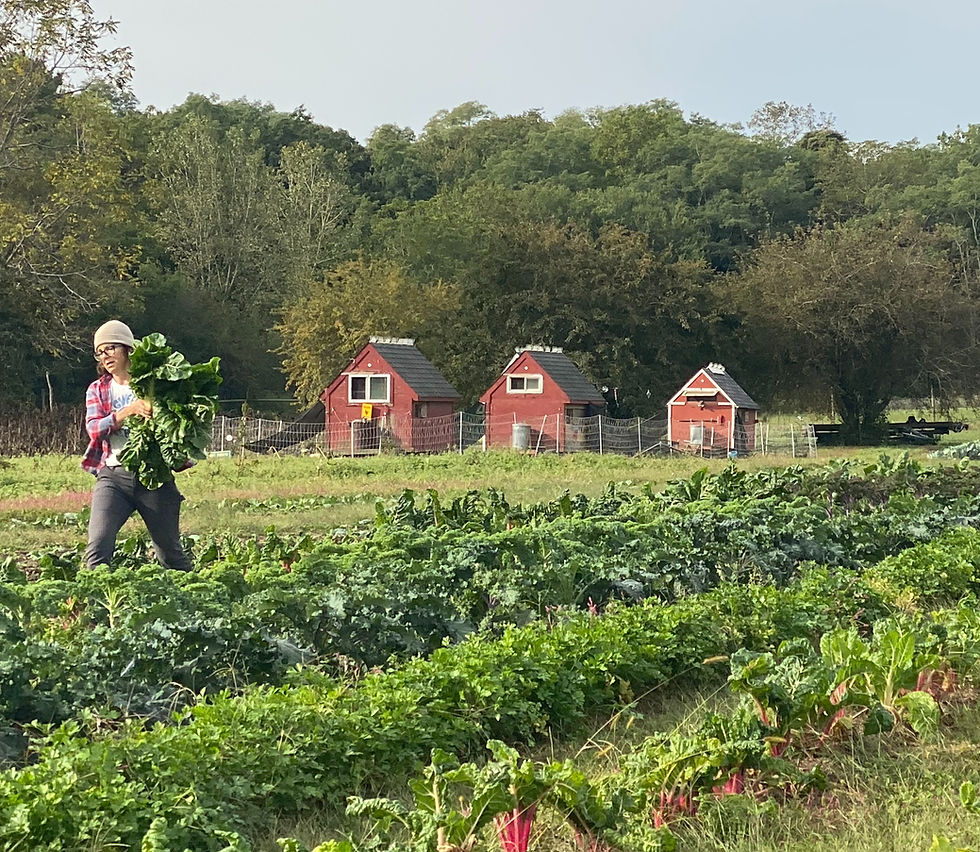
The upcoming changes largely pertain to our CSA program. The volume, variety, and price of the shares will be scaled back, and pickups will begin in early June, rather than late May. CSA members will be able to supplement from the farm stand, the capacity of which not be impacted, apart from a reduction in the most labor-intensive crops. Farm stand customers, we hope, will hardly notice a change. Out in the fields, we will allow up to one quarter of the farm's 5 acres to lie fallow. The CSA pick-your-own program—a highlight for many families—will remain unchanged. On the staffing front, we will shift from full-time to part-time employees, so that I can shift from full-time to part-time supervisor. On the days without staff, Dan and I will be working together, mostly with machines. For projects that require a big crew, we will recruit per diem staff and volunteers.

Planning, communicating, and implementing change is never easy, but I’m excited about the groundwork being laid. I’m happy the fields will have a chance to rest. I’m excited for a more manageable workload for myself, and for the insight and ideas that bubble up when one’s brain isn’t entirely consumed by the daily grind. Finally, I feel empowered to face the changes ahead. At some point, our state of contract limbo may become untenable, and when it does, we need to be ready; now, I feel ready. And to return to a question that’s shadowed me since the pandemic, what is the succession plan? More pointedly, who—or what—will replace me and Dan when we leave? The planning should start now, even if our departure is still a ways off. Given that we don’t own the land, there’s only so much we can control, but after almost two decades of vegetable production, soil-building, and community support, not to mention a crowd-funded deer fence, the foundation has been laid for farming to continue, in any form. It's just a matter of choosing the form.
Recently, someone posed an interesting question to me and Dan: if we could go back in time and wave a magic wand, what's the one thing we would change about the farm? Almost reflexively, I said ownership. That is, I wish we could have owned and lived on the farm. My answer surprised Dan, as I’d always touted our public-private partnership in the past, but I had my reasons. First, I was frustrated by the state of our contract, and the fact that our landlord—county government—changes with each election cycle. Second, I simply wanted to be closer to my kids. When they were little, the farm was their home away from home, but now, as teenagers, they spend most of their time at school and with friends; Dan and I, meanwhile, remain anchored at the farm. My decision to join the Amityville school board was, among many things, an attempt to bridge that gap, but one year of service was all I could manage before almost losing my grip on the farm. I’ll never know if farming and motherhood would have been easier if we owned the land, as there’s no going back in time with a magic wand. Any successor, therefore, must embrace the pros and cons of non-ownership as Dan and I did. We credit our success to timing, luck, and sheer stubbornness—a winning hand that allowed us to hang on through years of change. But what are the odds someone else will be able to replicate that hand? Pretty low, I think. That’s why, when I think of succession, I don’t envision a lone individual or couple, but rather a coalition of stakeholders—public, private, and nonprofit, with farmers at the center. Such a coalition, I believe, stands the best chance of providing stability through change, whether it’s changing markets, changing governments, or changing social trends. Change is inevitable, but food will always be essential, and I’m hopeful that with the right people and vision, farming at Old Bethpage can continue for another 20 years—at least! Now that I’ve freed up some time, I’m ready to connect with the people who want to shape that vision, and the farm’s future.
Back to 2025, we owe a huge shout-out to the many people who kept the farm humming along this year. To our crew—Nancy, Jackie, Thomas, Alice, Vivian, and Sarah—who busted their butts to produce an amazing volume of food. To Ann, Yvette, and Kobi, who kept the Tin House tables stocked and the customers happy. To Papa, who took care of the regulars when contract uncertainty suspended shopper shares. To Susan Salem, who delivered our extras to emergency feeding programs across Long Island. To Judy, Glenn, and Maryellen, for promoting diversity in the fields. To John McGowan and Tim Ging for the egg deliveries. To Tim, Jeff Morrison, and Bryan Coakley, for all the sweet potato cleaning. To John Royal for the music. To John DellAquila for the sourdough. To the CSA members who heeded the call when there was garlic to be mulched, cleaned, or planted. This season wouldn’t have been the success that it was without you!

Dan and I wish you all the best this holiday season. We look forward to embracing the changes and sharing the farm's journey with you in 2026!
Thanks for reading
—Caroline


Comments