
Back to School
Mar 18
4 min read
March 18, 2026
That’s been the theme this winter. Prior to January, I hadn't attended a single farm conference or forum since 2019, partly due to the pandemic, and partly due to life just being so dang busy. But I made a New Year’s resolution to make up for lost ground, and with the kids now old enough to fend for themselves (mostly), following through was not hard. I started off with Dan at the Long Island Agricultural Forum in Riverhead, hosted by Cornell Cooperative Extension. Then I traveled solo to the NOFA-NY winter conference in Westchester, and later to the Hudson Valley Young Farmer’s Coalition summit in Kingston. Then Dan and I attended the NOFA-Massachusetts conference at UMass Amherst, where we met up with former crew member Adam Li. Adam is completing his senior year at the Stockbridge School of Agriculture, and he gave us a VIP tour of the student-run farm and greenhouse conservatory. Then off to the conference itself, where Adam and Dan stuck to the technical workshops, while I opted for anything to aid my ongoing pursuit of a succession plan. Spoiler alert: I think the farm's future lies in education.

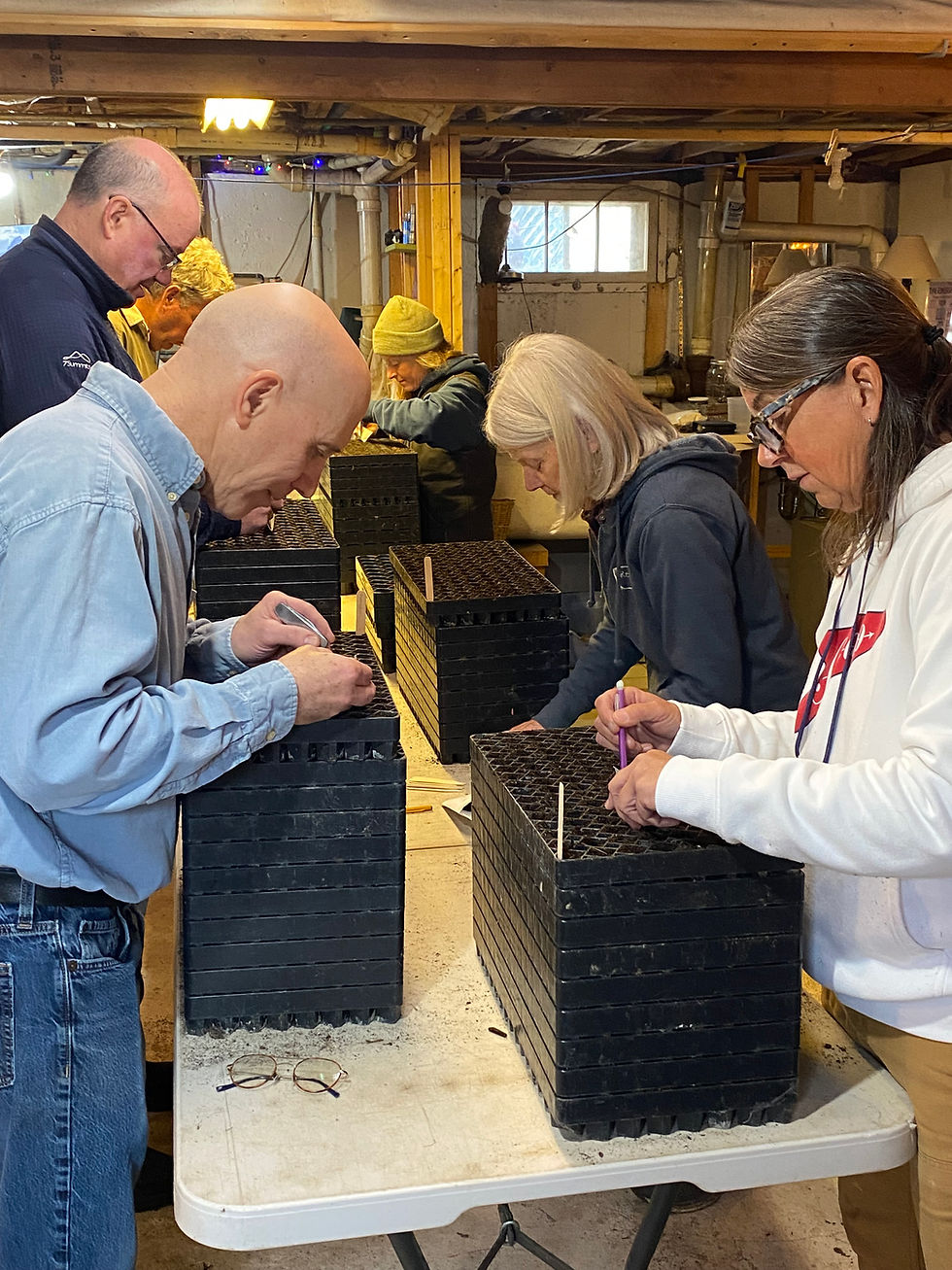
Days after the UMass conference, we started the first of the 2026 seeds. Jackie, Judy, Maryellen, Glenn, Tim, and Bryan gathered in our basement to start the onions, leeks, and scallions. It’s the most tedious seeding of the year—the seeds are tiny and the seeding rate dense—so it’s a good thing it’s also the first seeding of the year. By late winter, everyone is eager to get their hands back in the dirt, no matter the job. By July, it's hard to summon the same energy and patience.
Last weekend we had our final winter farm stand. Johnny Breads was back with his organic sourdough, Jackie was back with her DIY dried flower bouquets, and bulk bags of beets, carrots, and potatoes were flying off the tables. Now the walk-in cooler is mostly clear, and for me, that brings a sense of relief. Our makeshift walk-in cooler—an insulated room with an AC—is perfectly suitable for short-term storage during the summer months, but for long-term winter storage, nothing beats a proper refrigerator or root cellar. Crops prefer not to be subjected to extreme fluctuations in temperature, but with March coming in like a lion and going out like a lamb, it's hard to maintain a stable climate in the walk-in. After years of trying to make do—and of trying to sell limp and sprouted veggies in April and May—I finally decided to cut my losses. For all the work that goes into growing these crops, we shouldn’t allow them to degrade past a certain point in storage. Thankfully, whenever we have extras in need of a happy home, food rescuer Susan Salem is just a phone call away.

On Sunday we had our final winter walk. These walks often include an diverse mix of people—different ages, different zip codes, and different levels of familiarity with the farm. This time we had Bill Boecker, CSA member since 2008 and occasional farm stand bass player; Theresa and Mike Hearney, CSA members since 2024; and a Japanese dad with his two small children, living here on temporary work assignment. Capturing the attention of both adults and kids during a walk is balancing act; throw in a language barrier, and things really get tricky. But farming has it own universal language. So when we encountered a pair of Canadian geese in Lower Crooked field, I decided to demonstrate pest control. Nothing captures attention like a grown woman chasing geese while barking like a dog. From there we stepped over to New Pond field, where a cover crop of tillage radish lay in various states of decay. I pulled up a desiccated radish and called it by its Japanese name—daikon, or "big radish"—which elicited both smiles and grimaces. The radish had no value as a cash crop, I conceded, but it had served its purpose as a cover crop, having drilled deep into the soil and broken up compaction through the fall. Then we moved on to the garlic, whose tops were just poking through the mulch. I wrestled a clove out of the ground and handed it to the kids, who marveled at the thick mass of roots. From there on to the blackberries, where floricane pruning was underway—no need for narration when there’s a clear before and after visual. By the end of the tour, the geese had returned to Lower Crooked, and this time, it was Bill who did the barking.
With no more conferences or farm stands for another month, we're turning our complete attention to spring preparations. But mark your calendars. We reopen April 25, and when we do, there's a lot of fun—and more school—in store.
Thanks for reading and see you at the farm.
—Caroline
Upcoming Events
April 25 Cover Crop Workshop @ Restoration Farm, co-sponsored by NOFA-NY and the Real Organic Project (event details TBA)
May 1 Farm-to-Table for Schools Workshop @ OBVR
5/2 FIGSTOCK
5/8 & 5/9 Plant Sale
5/18 Kids Rock Hunt


Comments