
Founding Farmers
Jul 4
5 min read
July 4, 2026
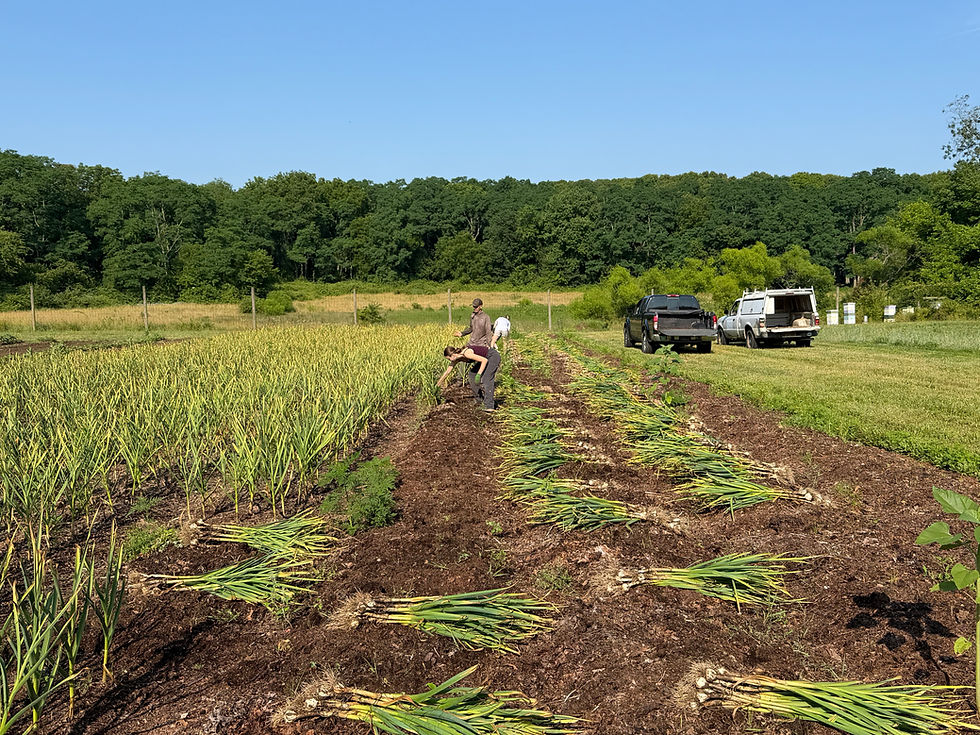
We’re standing at the season’s peak, looking down. Garlic harvest has begun. Spring greens are about to be plowed under. Summer fruits are ripening, and winter storage crops are coming along. Now we begin the descent towards fall.
Ordinarily, July is when I start drafting the field map for the following year. As cash crops exit the fields, cover crops go in, and what varieties to plant where depends on next year’s field map. In that regard, the cash crop-cover crop rotation is a chicken-or-the-egg scenario. But what to plant with no cash crops on the horizon? That’s a scenario I’ve never faced. For guidance, I turned to Mary-Howell Martens, founder and owner of Lakeview Organic Grain, near Rochester, NY. I’ve looked up to Mary-Howell since I became a Lakeview customer years ago, and heard her present at a NOFA conference, in which she explained, unapologetically, that enrolling her three children in school was the right decision for her family, despite an implicit assumption that she would homeschool and run a business. As a young mother also feeling a certain pressure to homeschool, I took courage from Mary-Howell's firm stance. Since then, I’ve looked forward to the annual Lakeview order as an innocuous opportunity to pick her brain. In response to my current inquiry, she advised planting a timothy clover “meadow,” which can protect and improve the land with little attention beyond periodic mowing. She also offered words of encouragement that nearly brought me to tears. Having recently scaled down her own business, she understands where I'm at now. For decades, my mind has been fixated on the field-to-market pipeline. Attending to it gave me purpose and pride. Closing it down feels like canceling a part of myself. A perennial meadow, however, is a fallow middle ground that stands to keep my farmer's sense of self—and hope—alive. So a clover timothy mix it will be. And thank you, Mary-Howell.

Meanwhile, there’s another pipeline competing for attention, and here’s where I try to weave together the divergent threads that have become my life. Last spring, Ada and I took a road trip to visit SUNY schools upstate. While listening to the “Hamilton” soundtrack, I bristled at a disparaging comment made about John Adams. Next thing you know, she and I are binge-watching the HBO series based on David McCullogh’s brilliant biography, I’m re-reading the biography itself, and Ada is on her way to admiring Adams as much as I do. Why bring this up? Because with some Americans thrilled to celebrate the nation's 250th birthday, while others don’t know what to celebrate, I want to give a shout-out to this often-overlooked founding farmer who, like Mary-Howell, has inspired me for years. Unlike Washington and Jefferson, Adams rejected slavery and grew his own crops. A prickly lawyer who loved country and abhorred a mob, he successfully defended the British soldiers who fired in self-defense during the Boston massacre. "Facts are stubborn things,” he famously stated at the trial.
Adams himself was a prolific writer, but he recognized the expediency of having a Southerner—Jefferson—author the Declaration of Independence. Nevertheless, it was Adams who got the Declaration signed, arguably the harder job. For New England delegates in 1776, independence couldn’t come fast enough, yet even by June, a handful of mid-Atlantic and Southern delegates still called for reconciliation. With his farmer’s sense of timing, Adams pulled the reins on some and prodded others, so that when the Declaration was finally signed, it was nearly unanimous.
Adams also drafted the Massachusetts constitution—the foundation of the U.S. Constitution—which called for the separation of powers and taxpayer-funded public education. Adams believed democracy could only be upheld by an educated citizenry. Thus, it was a matter of necessity, not charity, that the government invest in public education. Circling back to pipelines, I’ll attribute this, too, to Adams' sense as a farmer. You can’t harvest what you didn’t plant, you can’t know what you didn’t learn. For all of this and more, Adams is a rockstar in my book.

Yet in 2026, we're far from a democratic utopia. Farm policy is broken, public education is breaking, and partisan rage is tearing society apart. Americans are discouraged and frequently tempted to tune it all out, but here’s the thing: democracy was always messy and hard. Washington was the only president without a party, and when Adams tried to put country above party, he lost re-election to Jefferson. In terms of party politics, there’s nothing unprecedented about today. What is unprecedented is the 24/7 flood of junk food and junk media that’s turning our bodies and brains to mush. Far from the informed, engaged citizenry that Adams envisioned, we're turning into a malnourished, easily-triggered mob. The only way out, I believe, is through better food and better education. Which is why, if there’s anything that stands to give me as much hope as planting seeds, it’s teaching kids.
Out in the fields, I’ve been trying to do both. For the past two Wednesdays, we’ve had a crew of teens and young adults helping out, which has inspired me to recreate, to whatever extent possible, the conditions that made me fall in love with farming when I was twenty. Full disclosure: the crew is mostly family, and I’ve been laying on the this-is the-last-season-so-you-better-get-your-butt-out-here guilt real thick. But thanks to Sophia Marchioli and Charlotte Marino, college students whose mothers aren’t pressuring them, there’s the palpable sense that farming can be fun. I work alongside the crew long enough to demonstrate proper technique, and to explain the why—why it’s important to plant in the center, why we sort garlic for size, and so on. Then I fall back to allow space for trial, error, and camaraderie. Make no doubt, this is no way to run a commercial farm, where every minute, step, and leaf matters, but I’ve come to terms with the fact that a 5-acre farm on public land shouldn't be commercial in the traditional sense of the word. It should be productive and educational, however we define those words.


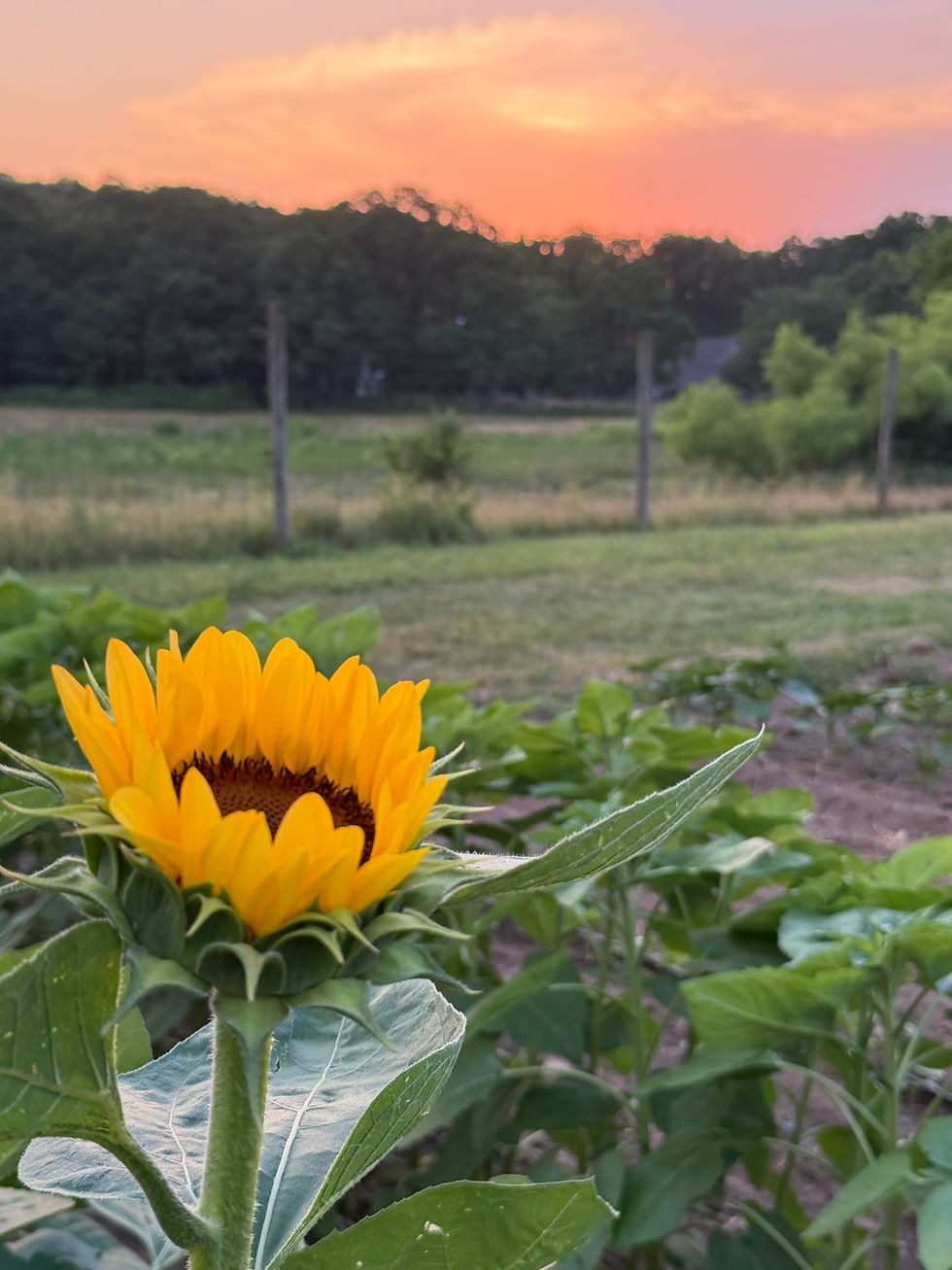
Meanwhile, a “heat dome” has settled over the eastern U.S. Today’s high was 100°, and experts are urging people to stay indoors. But that’s just not an option for farmers. Fortunately, since the Saturday farm stand is closed for the 4th, we managed to quit the fields early. Jackie, Nancy, and I started at dawn, harvesting squash and cultivating lettuce until mid-morning. I stalled out on the tractor (keyway again), which required an afternoon tow from Dan, so I took advantage of the 4-hour interim to finish this newsletter in the walk-in cooler. And throughout the day, not to my surprise, CSA members braved the heat to pick blueberries, herbs, and sunflowers. It was a typical July day—hot and difficult and productive and nourishing and beautiful all at once. I’d like to think John Adams would be proud.

So on that note, happy 250th birthday to us! Whatever your background or creed, I hope you find a way to take inspiration from—and help uphold—our nation’s commitment to life, liberty, and the pursuit of happiness.
Thanks for reading,
Caroline


Comments